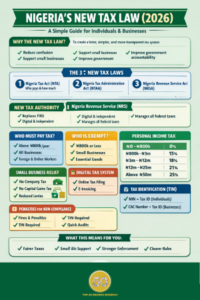

Either you are a business or individual, you must have heard about the Nigeria’s new tax regime, which start from this January. If you are confused, worried, or tempted to ignore it all together, you are not alone. For many people, taxes feel complicated, distant, and sometimes appeared unfair. But this time fam, the changes are too important to ignore.
So, Nigeria begins operating under a new tax system that affects individuals, small businesses, large companies, foreign investors, online businesses, and even government agencies from this January. We are taking this time to explain the new tax laws in plain language, without legal jargon, so that anyone can understand what is changing and why it matters.
Why Nigeria Changed Its Tax System?
Nigeria’s old tax system was made up of many different laws passed at different times. This has created:
- Confusion about who should pay tax
- Multiple taxes on the same business
- Weak enforcement
- Loss of government revenue
- Unfair pressure on small businesses
To fix this, the Federal Government introduced a new, well-structured and unified tax framework that are designed to be:
- Clearer
- Fairer
- More transparent
- More digital
- More aligned with global standards
The reforms are not about punishing taxpayers, necessarily. They are meant to make compliance easier, ensure that those who earn more contribute more, and allow government at all levels to function better. Well, that’s left to the tax payer’s judgement.
Nigeria’s new tax system is built on three major laws:
-
Nigeria Tax Act (NTA)
This law answers one big question:
Who pays tax, and how much?
It defines:
- Tax rates
- Exemptions
- Levies
- Rules for individuals and businesses
For the purpose of explanation, let’s think of this as the rulebook.
2. Nigeria Tax Administration Act (NTAA)
This law explains how taxes are collected, who collect, tracked, and enforce them.
This covers:
- Tax registration
- Digital filing
- Penalties
- Dispute resolution
Think of this as how the rules are enforced.
3. Nigeria Revenue Service (Establishment) Act (NRSEA)
This law creates a new, more powerful tax authority to oversee the system. Putting the three together for explanation purpose – NTA sets the rules of the game, the NTAA explains how the game is played, and the NRSEA appoints the referee, this time, the Nigeria Revenue Services (NRS).
The Nigeria Revenue Service
This is the new tax authority that has now replaced the FIRS and gives the new agency more independence, funding, and digital capacity.
What Has Changed Under the New System?
A New Tax Authority: NRS
The Federal Inland Revenue Service (FIRS) is now the Nigeria Revenue Service (NRS).
What this means for taxpayers?
- A stronger, more professional tax authority
- Better technology
- Less manual paperwork
- Better accountability
The NRS is funded directly from non-oil revenue, allowing it to modernise systems and improve service delivery.
Support for Small Businesses
For the first time in a long while, according to the law, the new tax laws clearly recognise that small businesses need room to grow and exempt many of the from taxation.
Who Is Considered a Small Business?
A company that earns ₦50 million or less per year (some thresholds apply up to ₦100 million though, depending on category)
The Tax Relief They Get:
Small businesses are exempt from major taxes, including:
- Company Income Tax
- Some levies
- Capital Gains Tax
This is designed to help Startups, Traders, Retailers, Small manufacturers, Creative and tech businesses
The idea is simple: Grow first. Pay more later. Good right?
What About Big Companies and Multinationals?
- Large companies are now expected to pay their fair share.
Key changes include:
- Higher Capital Gains Tax (aligned with company income tax)
- A minimum tax for multinational companies
So, this means large foreign companies can no longer operate profitably in Nigeria while paying little or no tax, employing some accounting tricks. Even if they file low profits, they must still pay a minimum amount. Clear?
Well, this is meant to align Nigeria with global efforts to stop tax avoidance.
Personal Income Tax: What Individuals Should Know
For individual that earn ₦800,000 or less per year, they are exempted from tax, that is, no personal income tax.
This is meant to protect:
- Low-income workers
- Many informal sector participants

Well, some good news for low-income earners
Higher Earners Pay More
Well, Nigeria now uses a progressive tax system:
The more you earn, the higher your tax rate and this can go as high as 25%
This, according to experts is meant to reduce inequality and spread the tax burden more fairly.
VAT: What Changes for Businesses and Consumers
VAT still remain at 7.5%, but it is now more practical.
Key improvements:
- Businesses can recover VAT on more expenses
- Essential goods (food, medicines, basic items) are VAT-free
- Exported goods and services may be zero-rated
This is meant to help in reduce business costs, lower prices for consumers and improve competitiveness
Everyone Must Register for Tax
Under the new system, tax is a must one way or another
- Every taxpayer must have a Tax Identification Number (TIN)
Important updates for Simplicity,:
- Your National Identification Number (NIN) now automatically serves as your tax ID if you are an individual
- Your CAC registration number is your tax ID if you are a registered business
Without a TIN:
- You may not access government contracts
- Banks and partners may restrict transactions
Well, the Nigerian tax system is now fully digital
- Tax filing is online
- VAT reporting is digital
- Businesses must use e-invoicing
The effect of this will reduce:
- Corruption
- Paperwork
- Delays
Much more, it also means compliance is easier to track.
Stronger Enforcement and Penalties
The new laws introduce tougher penalties:
- Fines for late filing
- Heavy penalties for operating without a TIN
- Sanctions for false reporting
Even government agencies are no longer exempt. Unpaid taxes can now be deducted directly from their budgets.
Faster Dispute Resolution
If you disagree with a tax assessment:
- Your objection must be resolved within 90 days
- If the tax authority fails to respond, the taxpayer automatically wins
This protects businesses from endless disputes.
To sum it up –
- Small businesses get relief
- Low-income earners are protected
- Big companies face accountability
- Tax becomes digital and transparent
- Government agencies must comply
- Everyone must register
Don’t panic. Get informed. Prepare early.
Understanding the new tax system now puts you ahead, whether you are an individual, a startup founder, a growing business, or an investor looking at Nigeria.
Please be informed.