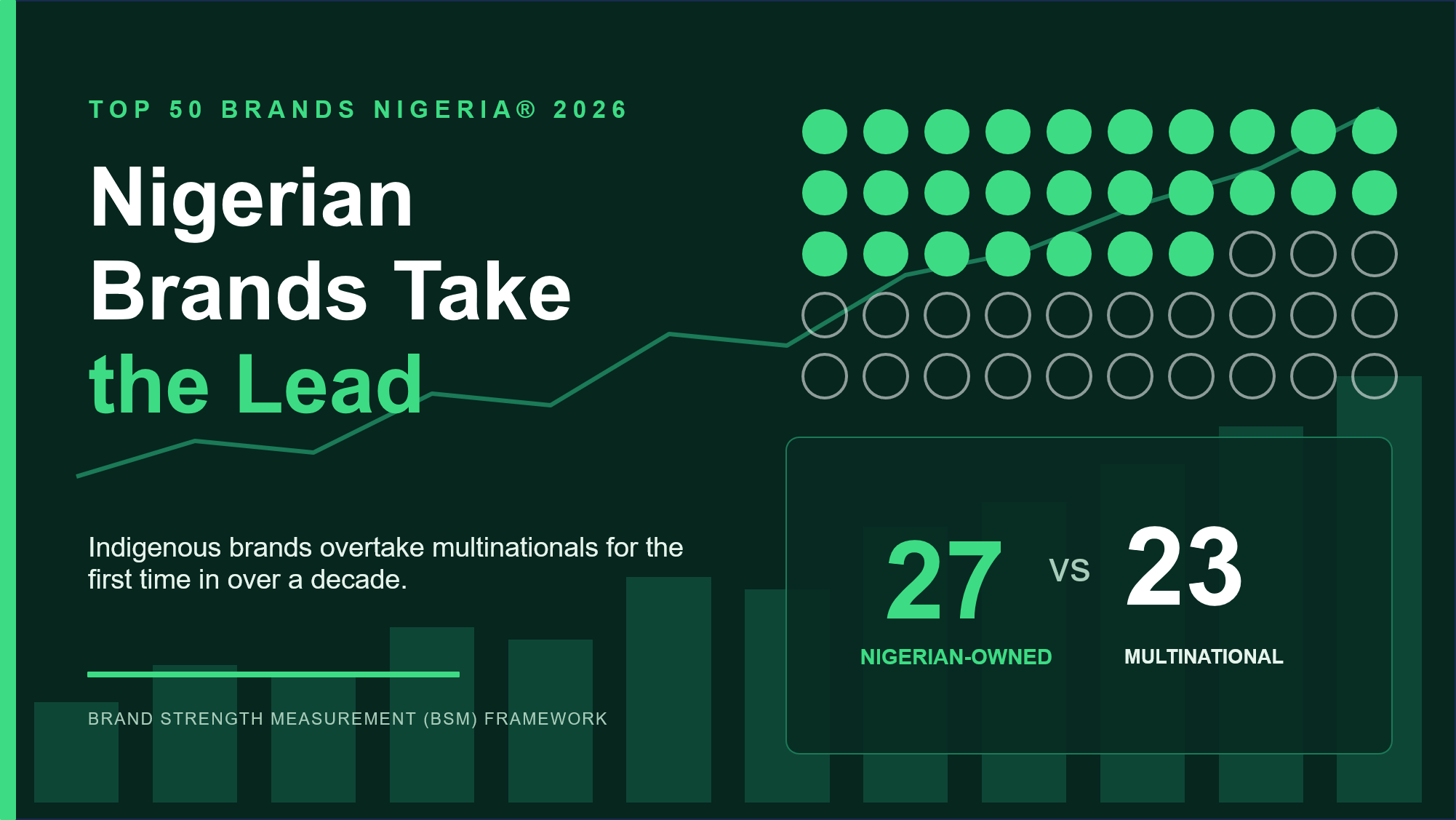
From equal representation in 2025 to indigenous majority in 2026, Nigerian-owned businesses are demonstrating growing strength, competitiveness and relevance in the country's corporate brand landscape.
In a significant development for Nigeria's corporate and businesses, Nigerian-owned brands have, for the first time in more than a decade, overtaken multinational brands in the TOP 50 BRANDS NIGERIA® annual ranking.
The 2026 assessment records 27 Nigerian-owned brands against 23 multinational brands, giving indigenous businesses a majority representation of 54 per cent of the country's 50 leading brands.
This marks a notable shift from the 2025 ranking, when Nigerian-owned and multinational brands achieved equal representation, with 25 brands each. For many years, multinational companies had generally maintained the numerical advantage, benefiting from international brand heritage, established systems, substantial resources and extensive market presence.
The latest result therefore represents more than a change in numbers. It signals the growing ability of Nigerian businesses to build strong brands, compete effectively, earn consumer confidence and establish themselves across key sectors of the economy.
A defining moment for Nigerian enterprise
For years, Nigerian consumers have interacted with products and services from multinational corporations whose brands enjoy global recognition, established reputations and significant market presence. However, indigenous companies have increasingly strengthened their competitive positions, expanded their reach and demonstrated the capacity to build businesses that resonate strongly with Nigerian consumers.
Across banking and financial services, telecommunications, manufacturing, consumer goods, construction, energy, media and financial technology, Nigerian-owned businesses are becoming increasingly visible and influential.
The 2026 results demonstrate that homegrown brands are no longer merely participating in the competition for consumer attention and market relevance. They are increasingly influencing it.
Seven Nigerian-owned companies also emerged among the overall top ten brands, further showing the strength of indigenous businesses at the highest level of the ranking.
This is an encouraging indication of the resilience and growing competitiveness of indigenous enterprise, particularly in an operating environment characterised by economic pressures, changing consumer purchasing power, infrastructure constraints and intense market competition.
However, the result should not be interpreted as a decline in the importance of multinational brands. Their continued presence, with 23 positions, demonstrates that international businesses remain important participants in Nigeria's economy and continue to compete strongly for consumer confidence and market relevance.
The emerging picture is one of stronger competition and a more balanced, increasingly competitive corporate landscape.
The BSM framework: Performance, not ownership
The 27–23 result is particularly significant because the ranking is not determined by whether a company is Nigerian-owned or multinational. Every brand is assessed against the same Brand Strength Measurement (BSM) framework.
The BSM is a multi-dimensional evaluation model designed to measure brand strength through indicators of consumer awareness, public perception, sentiment, digital engagement, category leadership, innovation and quality, national presence, and corporate social responsibility.
Its purpose is to assess how strongly a brand connects with its market and how effectively it sustains relevance, confidence and competitive standing.
This means Nigerian-owned and multinational brands compete on the same assessment basis. No preference is given to a brand because of its ownership, origin, size or international heritage. Their positions are determined by their performance against the evaluation criteria.
The 2026 outcome is therefore meaningful: Nigerian-owned brands have earned more positions in the Top 50 under a common evaluation framework. It is a reflection of brand performance, not a nationality-based preference.
From Local Champions to Brands with Global Ambition
Well, the next opportunity for Nigerian brands is to translate their growing domestic strength into greater international competitiveness.
A strong position in the Nigerian market provides a foundation, but the long-term ambition must go further: developing products and services that can compete beyond national borders, building trusted corporate identities, investing in innovation, maintaining consistent quality and creating brands that command confidence in international markets.
Nigerian businesses have demonstrated their ability to build scale and establish meaningful relationships with consumers. The challenge now is to deepen that progress and convert it into enduring brand equity, export competitiveness and global recognition.
For multinationals, the message is equally clear: Nigeria remains a significant market where sustained relevance depends on understanding local consumers, delivering value and continually earning trust.
The 2026 ranking is not a declaration that one group has displaced the other permanently. Rather, it reflects a changing competitive environment in which Nigerian businesses are becoming stronger participants and increasingly influential market leaders.
A new chapter in the story of Brand Nigeria
The findings of TOP 50 BRANDS NIGERIA® 2026 post an important message: Nigeria's corporate identity is now being shaped not only by international companies operating within its borders, but increasingly by Nigerian businesses that are building, innovating and competing at home.
The rise from equal representation in the previous year to a 27–23 majority now, is an encouraging milestone for indigenous enterprise. However, it also comes with a responsibility. Brands must continue to invest in quality, integrity, innovation, customer experience and responsible leadership. The objective should not simply be to make the list, but to build businesses and brands that remain relevant, trusted and competitive for generations.
The numbers have changed. The competition has intensified. And Nigerian brands are increasingly taking their place at the forefront.
27 Nigerian-owned brands. 23 multinational brands. One competitive marketplace. One evolving Brand Nigeria.
This is more than a ranking result. It is a statement about the growing strength of Nigerian enterprise.