A Nation's Brand Story Retold - What the Rankings Really Tell Us
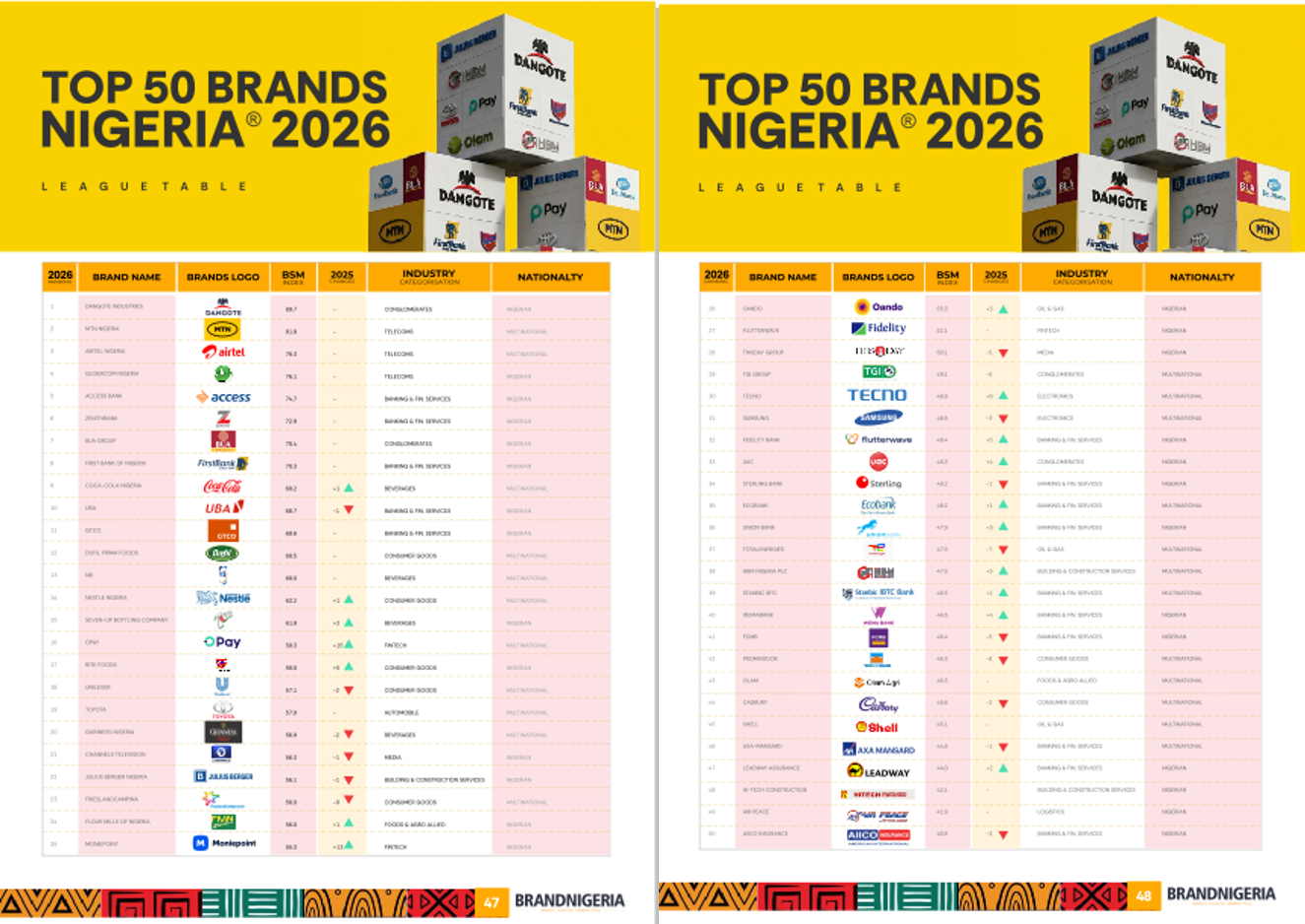
Every year, the TOP 50 BRANDS NIGERIA® league table does more than ranking brands by a number. It captures the shifting mood of the brands (companies) that power Nigeria. The brands that Nigerian consumers trust, who they cannot do without, and in a way, those who has quietly slipped while nobody was watching. The 2026 edition, which is built on the familiar Brand Strength Metric (BSM) Index tells a particularly interesting story this year. For the first time in over a decade this annual study, Nigerian-owned brands have overtaken multinationals on the list, with 27 home-grown brands against 23 foreign-owned (Multinationals). This signals something bigger than marketing performance, it hints at a maturing economy where local enterprises are increasingly able to stand toe-to-toe with, and in many cases outperform, global giants operating on Nigerian soil.
Dangote's Ninth Crown
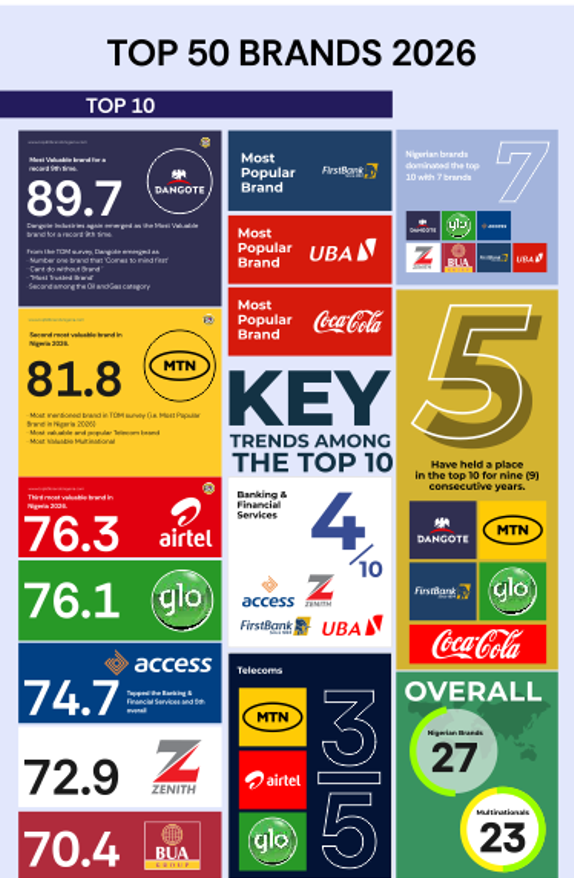
At the very top of the table this year sits Dangote Industries, with a commanding BSM Index of 89.7, highest BSM till date. This is not a fluke and not a one-off spike in popularity. It is the ninth time Dangote Industries has been crowned the most valuable brand in Nigeria. This is a feat that borders on the extraordinary in an industry where consumer sentiment can be fickle. Nine years of sustained dominance suggests something structural rather than accidental: a brand that has embedded itself into the everyday psychology of the Nigerian consumer.
The Top-of-Mind survey also shows this. Dangote was named the brand that "comes to mind first" when Nigerians were asked to name a brand, unprompted. It was also identified as the brand consumers "can't do without" and, also the "most trusted brand" in the entire market. In an economy where trust is often in short supply, with inflation pressure, currency pressures, and inconsistent service delivery creates weariness, being named the most trusted brand is arguably a bigger prize than topping the BSM Index itself. A multi-sectoral conglomerate, Dangote also ranked second within the Oil and Gas category. This gives it a breadth of consumer touchpoints that not many competitors can match.
MTN Nigeria’s Unwavering popualrity
MTN Communication Nigeria Plc emerged second on the Most Valuable brand league table again this year with a BSM Index of 81.8, and more importantly, it emerged as the most mentioned brand in the entire TOM survey, making it the single most popular brand in Nigeria this year. For over 2 decades MTN has maintain its ‘everywhere you go’ mantra.
MTN did not simply win on popularity; it also secured the title of most valuable and most popular telecom brand, and perhaps most significant from an industry-watching perspective, the most valuable multinational operating in Nigeria. In a year where Nigerian brands have collectively overtaken multinationals in numbers on the list, MTN's remarkable performance is a reminder that individual multinational players can still lead their categories decisively.
Airtel Nigeria came in third overall again this year, confirming that Nigeria's telecoms sector remains the most fiercely contested and emotionally resonant category in the country.
Three of the five most valuable brands in Nigeria this year are telecom operators- these are MTN, Globacom, and Airtel. This shows just how central mobile connectivity has become to everyday Nigerian life, which has become arguably, more central than any single consumer good.
Globacom, another proudly Nigerian brand is not relenting. The brand came 4th overall this year also.
Among the Top 10
The banking sector dominates the top 10 with four brands, with Access Bank claimed fifth place overall while also topping the Banking & Financial Services category outright. Zenith Bank followed in sixth, BUA Group in seventh, First Bank of Nigeria in eighth, Coca-Cola Nigeria in ninth, and UBA rounded out the top ten in tenth position.
Looking closely, four of the top ten brands are banks - Access Bank, Zenith Bank, First Bank, and UBA. No other single industry claims that much real estate inside the top ten. This is a meaningful signal. In a country where financial inclusion, digital banking adoption, and fintech disruption have all been major talking points in recent years, it is the traditional, long-established banks that continue to command the deepest consumer trust and recognition at scale.
Now, seven of the ten brands in the top ten are Nigerian-owned. These are Dangote Industries, Globacom, Access Bank, Zenith Bank, BUA Group, First Bank of Nigeria, and UBA. Only MTN, Airtel, and Coca-Cola represent multinational interests inside this elite circle. This is an early preview of the broader theme that runs through the entire 2026 table. Nigerian ownership is increasingly the norm at the very summit of Nigerian commerce. The numbers are showing it.
One of the most impressive statistics in this year's report is consistency. Five brands, that is, Dangote, MTN, First Bank, Coca-Cola, and Globacom have now maintained a position within the top ten for nine consecutive years. In the fast-moving, often turbulent world of Nigerian business, where currency volatility and shifting consumer habits can change fortunes overnight, nine years of uninterrupted top-ten presence is a genuine mark of institutional strength.
Across the entire list, twelve brands maintained their previous position from the previous year: Dangote Industries, MTN, Airtel, Globacom, Access Bank, Zenith Bank, First Bank, BUA, GTCO, Dufil Prima Foods, Nigerian Breweries, and Toyota.
Opay's Remarkable Rise
The astronomical rise and increasing influence of Opay in Nigeria has consistently show over these ast few years. No brand captures story of disruption in this annual ranking better than Opay. Sitting at sixteenth position overall with a BSM Index of 59.3, Opay posted the single largest year-on-year gain in the entire 2026 survey, climbing an extraordinary 15 BSM points. This is not the first time Opay has achieved this feat either; it is the second consecutive year the brand has emerged as the highest gainer in the entire ranking. It rose 10 places last year with 10 points jump, now 15 steps higher for the 2026 ranking.
Now, that kind of sustained, rapid climb tells its own story about how quickly digital financial services are being absorbed into everyday Nigerian life, reaching the unbanked from nooks and crannings of the ountry. Where traditional banks have spent decades building their brand equity, Opay has compressed a comparable trust-building journey into a fraction of that time, riding the wave of mobile money adoption, agent banking networks, and a generation of Nigerians who increasingly conduct financial transactions without ever stepping into a banking hall.
Opay is not alone in this fintech surge. Moniepoint also made an impressive rise to the twenty-fifth position with a BSM Index of 55.3, posting an increase of 13 points (YoY). Flutterwave, meanwhile, held steady at twenty-seventh position with a score of 52.1. Together, these three brands represent the fintech category's three entries on the list, and collectively they paint a picture of an industry that’s taking a quick, but strong footing at the top of the table but moving upward with real conviction. It would not be surprising if, within a few more survey cycles, one or more fintech brands begin challenging the established banking names for a spot inside the top ten itself. I see that coming in few years, maybe less than my finger counts
New Arrivals and Notable Movements
Every year's list carries a few surprises, and 2026 introduces exactly one brand-new entrant: Hi-Tech Construction, at the forty-eighth position with a BSM Index of 42.1. Its appearance on the Building & Construction Services list, alongside established names like Julius Berger and Lafarge, suggests a construction sector that continues to broaden even as infrastructure spending and real estate development remain central themes in Nigeria's economic conversation. This is the first time this sector will have three strong representatives
Elsewhere on the table, the movements are a mixed bag of quiet gains and notable declines. Tecno posted a healthy six-point rise to reach thirtieth position, making its position as one of the two electronics brands on the list alongside Samsung. This is a reflection of the continued dominance of affordable smartphone brands among Nigerian consumers. Fidelity Bank gained five points to climb to thirty-second position, while Wema Bank added four points, and Union Bank and Sterling Bank posted smaller but positive movements of their own, All these are evidence that the banking sector's mid-tier players are not standing still even as the traditional "big five" continue to dominate the upper table.
On the Sectoral bases
Here is the sectoral distribution of the Top brands at the 2026 brands evaluation. Banking & Financial Services remains, by a wide margin, the most heavily represented category, with fifteen brands on the, with Access Bank at topping the list. This is followed by Consumer Goods with seven entries, led by Dufil Prima Foods, and then each of Conglomerates, Beverages and Telecoms categories with 4 brands each. Conglomerate of course is led by Dangote Industries, MTN topped the Telecoms while Coca-Cola Nigeria led the Beverages cateory.
Smaller but still meaningful categories round out the picture: Fintech and Building & Construction Services each contribute three brands, led respectively by Opay Nigeria and Julius Berger. Oil & Gas also places three brands on the list, led by Oando Plc. Media contributes two entries with Channels Media Group at the top, while Electronics adds two brands led by Tecno, and Foods & Agro Allied contributes two brands led by Flour Mills of Nigeria Plc. Automobile stands alone as a single-brand category, represented solely by Toyota Nigeria. Toyota by the way has been the sole Automobile category in this annual top brand ranking for some years.
This distribution in itself is instructive. The sheer weight of the banking sector, fifteen out of fifty brands, nearly a third of the entire list is a confirmation that financial services remain the backbone of brand competition in Nigeria, even as fintech challengers nibble at the edges.
A Market Finding Its Own Voice
The TOP 50 BRANDS NIGERIA® league table, which has become a sort of annual corporate report card from consumers’ perspective is, on its surface, a ranking of corporate performance. But with a closer, it is really a portrait of a country's evolving relationship with the businesses that serve and power it. Dangote's ninth consecutive year at the top speaks to the enduring power of service, legacy and trust built over time. MTN's dominance in popularity speaks to the centrality of connectivity in modern Nigerian life. The strong showing of banks throughout the top ten speaks to an economy still dancing around its traditional financial institutions, even though, fintech challengers like Opay and Moniepoint post the kind of dramatic gains that suggest the ground beneath those institutions are somehow shifting.
But perhaps the single most important headline from this year's report is the one easiest to overlook; and that is, for the first time, Nigerian-owned brands outnumber multinationals on this list. Twenty seven Nigerian names against twenty three multinational is beyond just a statistical, it is a marker of a market that is increasingly being built, owned, and led by Nigerians themselves. It shows capacity, capability and competitiveness. Whether this trend continues to strengthen in the years ahead, or whether multinationals respond with renewed investment and repositioning, will be one of the most compelling storylines to watch in future editions of this report.