The Brands Winning Nigeria's Mental Space - Top of the Mind
There is a simple question that can tell us a great deal about the strength of a brand:
When you hear the name of a category, which brand comes to your mind first?
No list of names, no logos, no prompting, just the question.
That is the basis of the Top-of-Mind (TOM) survey conducted as part of the annual TOP 50 BRANDS NIGERIA® ranking. Respondents were asked, without being shown a list of brands, to mention the one company or brand that came to mind first across a range of important categories.
It is quite a simple exercise, but what people remember spontaneously can be more revealing than what they recognise when prompted.
The results tell an interesting story about the Nigerian marketplace. Some brands have achieved extraordinary levels of mental availability, effectively becoming synonymous with their categories. Others operate in much more fragmented spaces, where consumers' attention is divided among several competing brands.
And, perhaps most interestingly, when the category is removed altogether and Nigerians are simply asked to name any company or brand in Nigeria that comes to mind first, one name rises clearly above the rest -
Dangote.
The battle for mental space
Brand building is ultimately a battle for space in people's minds.
Consumers encounter thousands of commercial messages, products, companies and logos. Yet when a need arises, only a relatively small number of names are immediately available to them.
That is what makes Top-of-Mind awareness important.
In telecommunications, the answer is remarkably clear.
MTN is the first brand that comes to mind for 78.8% of respondents. Glo follows with 15.2%, while Airtel records 4.5%.
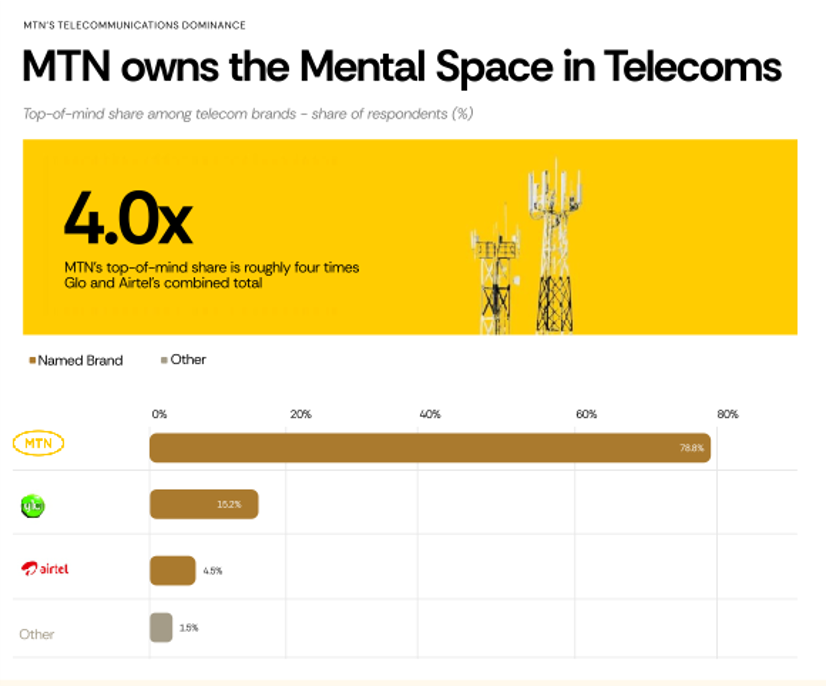
Put differently, almost four out of every five respondents spontaneously associate telecommunications in Nigeria with MTN. This is not simply awareness. It is mental dominance.
The automobile category produces another striking example.
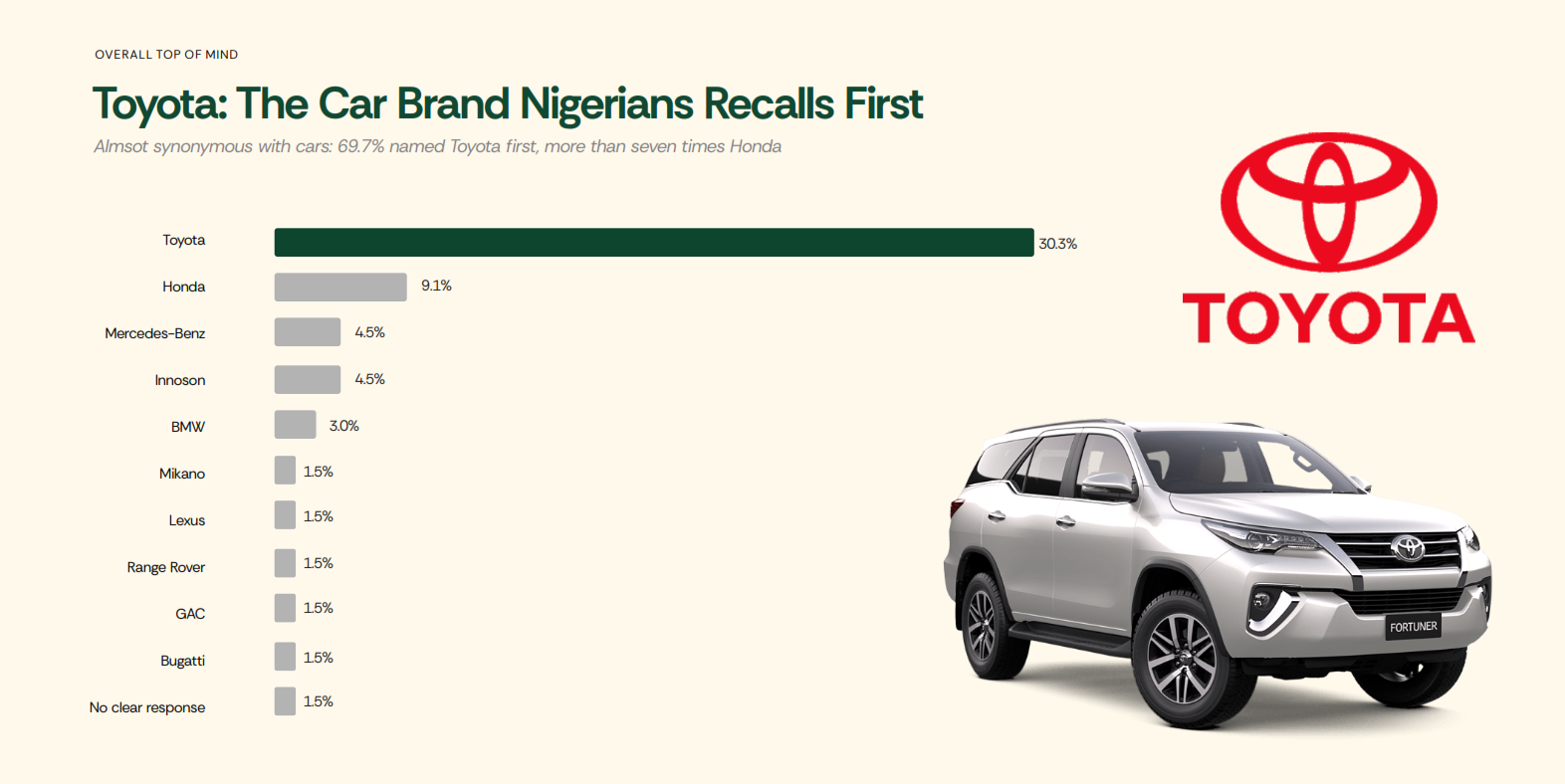
Toyota commands 69.7% of spontaneous mentions, compared with 9.1% for Honda. Mercedes-Benz and Innoson follow at 4.5% each.
Toyota's result shows how a brand can become almost interchangeable with the category itself. For a large proportion of respondents, thinking about cars in Nigeria appears to trigger Toyota before almost any other name.
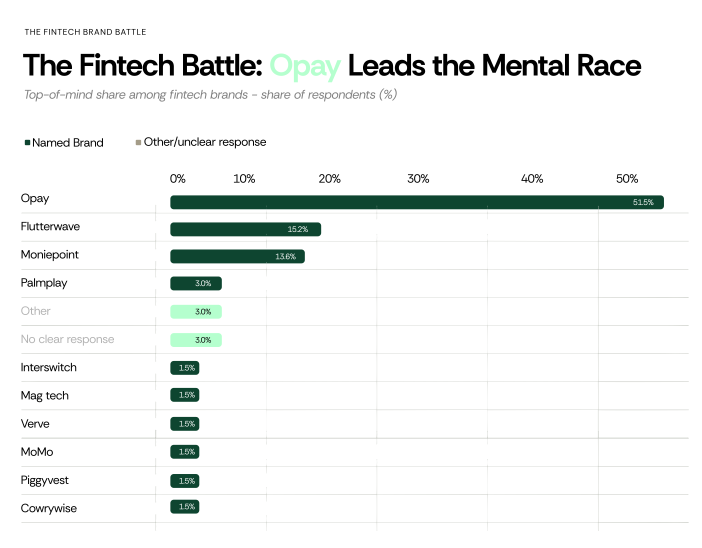
The pattern is repeated in FinTech, although in a much younger category.
OPay is the first FinTech brand that comes to mind for 51.5% of respondents. Flutterwave records 15.2%, while Moniepoint records 13.6%.
OPay therefore commands more than half of all spontaneous FinTech mentions and is more than three times ahead of the second-ranked brand.
For a sector that has experienced an explosion of new brands and platforms in recent years, this is a remarkable level of mental availability.
Banking is a different kind of battle
Banking presents a more competitive picture.
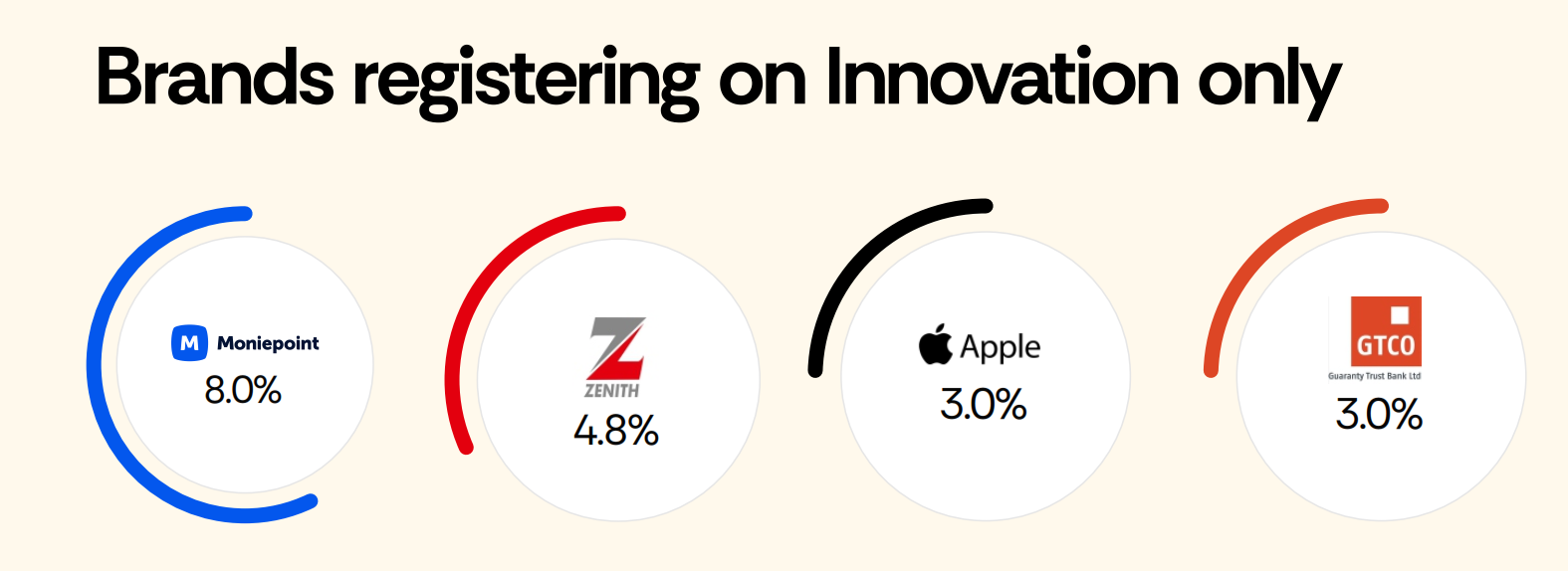
GTBank leads the category with 28.8%, followed by First Bank at 24.2% and Zenith Bank at 16.7%. Access Bank records 10.6%, while UBA records 4.5%.
The four leading banks together account for 80.3% of spontaneous mentions.
But unlike telecommunications, there is no runaway leader.
GTBank's lead over First Bank is only 4.6 percentage points. This suggests a category in which several established brands have built substantial and competing positions in consumers' minds.
The banking result is therefore less about one brand owning the category and more about a powerful group of established institutions fighting for mental availability.
Samsung, Coca-Cola and Channels TV
Other categories produce similarly interesting patterns.
Samsung leads technology and electronics with 36.4%, more than twice LG's 18.2%. Apple follows at 7.6%, while HP records 6.1%.
In drinks, Coca-Cola leads with 33.3%, followed by Rite Foods at 18.1%. NB and SBC each record 7.6%, while Guinness comes in at 6.5%.
Coca-Cola's lead is substantial, but the result also reveals a more fragmented drinks market, with 16.7% of responses falling into the "Other" category.
In media and entertainment, Channels TV leads with 30.3%.
But perhaps more interesting than Channels TV's lead is the composition of the brands that follow. Netflix accounts for 13.6%, YouTube 12.1%, and ThisDay/Arise TV another 12.1%.
It could be deduced from here that the Nigerian media is therefore no longer simply a competition between television stations and newspapers. Global digital platforms now occupy significant space alongside established Nigerian media brands.
For Consumer Goods - the market tells another story
If some categories are dominated by one brand, everyday consumer goods are much more fragmented.
Dufil Prima (Indomie) leads with 12.1%, followed by Rite Foods and Dangote at 9.1% each. Golden Penny records 6.1%, while Nestlé, Milo, Maggi and Knorr each record 3.0%.
The leading brand therefore accounts for only about one in eight spontaneous mentions.
This makes sense in a category encompassing a wide variety of products and consumption occasions. Consumers are not thinking about one homogeneous product category when asked about everyday consumer goods. They are drawing from a broad range of food and household brands encountered in daily life.
The implication is important: not every category can be won through dominance. In some categories, the objective is to build strong and distinctive positions across multiple consumer occasions.
NNPC leads energy, but Dangote is closing the mental gap
The fuel, energy and oil and gas category provides another revealing result.
NNPC leads with 24.2%, followed by Dangote at 18.2%. Oando and Mobil each record 12.1%, while MRS records 9.1% and BOVAS 6.1%.
NNPC remains the strongest spontaneous association, but Dangote's position is notable.
A company that has historically been associated with cement, manufacturing and other industrial interests is now only six percentage points behind NNPC in spontaneous association with the broader energy category.
The Dangote effect
The most revealing question in the survey may be the one that removes all category boundaries:
"When you think of any brand/company in Nigeria, from any industry, which ONE comes to mind first?"
Here, Dangote records 30.3%.
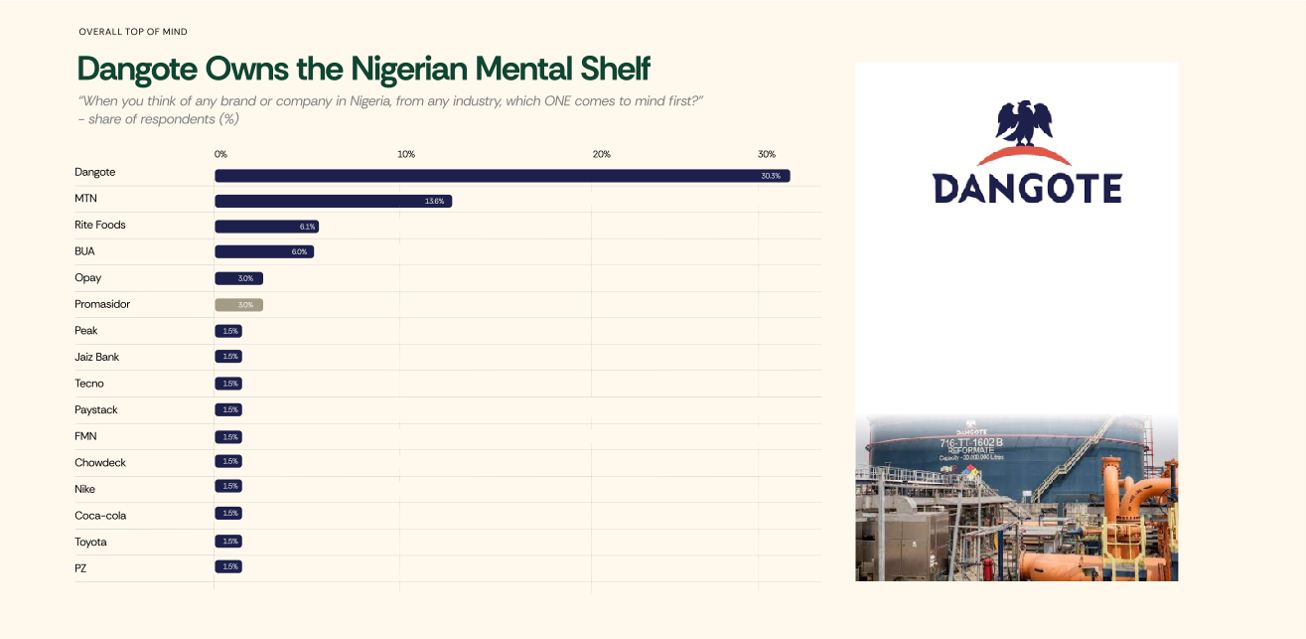
MTN followed at 13.6%. Rite Foods follows at 9.1%, Nestlé at 6.1% and BUA at 6.0%.
The result is significant because respondents were not being asked about cement, manufacturing, energy, food or any other particular sector. They were simply asked to think of a company. And almost one in three respondents named Dangote.
This suggests that the Dangote brand has developed a level of cross-category mental availability that extends well beyond any single business sector.
MTN dominates telecommunications. Toyota dominates automobiles. OPay dominates FinTech. Samsung dominates technology and electronics.
But when Nigerians are given a blank sheet and asked to name a company, Dangote comes through as the strongest spontaneous corporate association in this survey.
That is a different kind of brand strength.
From Awareness to Trust
When asked which Nigerian brand or company they trust the most, Dangote again comes first, with 16.1%.
OPay follows at 12.9%, Nestlé at 10.6% and Rite Foods at 8.0%.
The trust result is not identical to the TOM result, and that is precisely why it matters.
A brand can be famous without necessarily being trusted. It can be highly visible without becoming credible.
Dangote's leadership on both measures suggests that its strong mental availability is accompanied by a significant level of trust among the respondents surveyed.
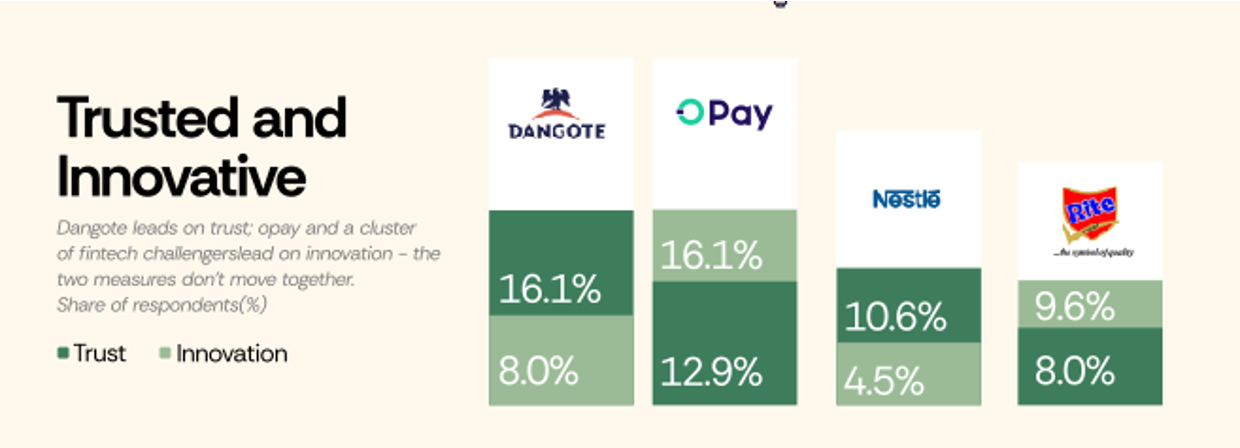
OPay presents another interesting case. It is the overall leader in FinTech TOM and comes second on the broader trust question. This indicates that its brand presence extends beyond simple recognition into a broader perception of relevance and credibility.
OPay and the Perception of Innovation
When respondents were asked which company they considered the most innovative, OPay took the lead at 16.1%.
Rite Foods, surprisingly followed at 9.6%, while Dangote and Moniepoint each recorded 8.0%.
The result gives OPay an interesting three-dimensional position in the survey.
It is:
the leading FinTech brand on TOM, at 51.5%;
the second most trusted brand in the overall trust question, at 12.9%; and
the most innovative brand overall, at 16.1%.
That combination suggests that OPay has succeeded in building not just visibility, but a distinctive perception around innovation.
The Indispensable Brand?
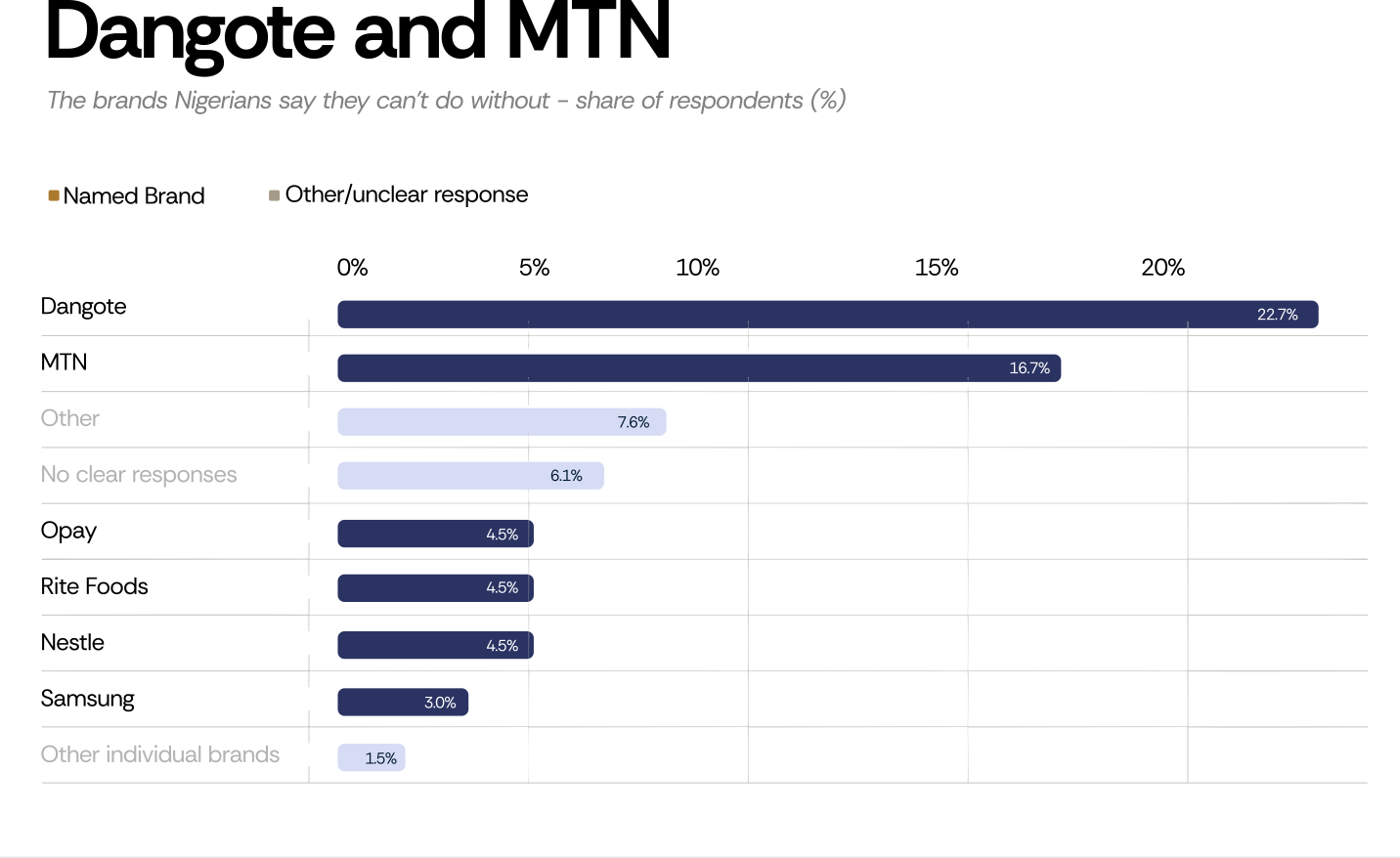
Another question asked respondents which brand or company they "can't do without" in Nigeria.
Once again, Dangote comes first, at 22.7%.
MTN follows at 16.7%.
OPay, Rite Foods and Nestlé each record 4.5%.
This is an intriguing measure because it moves beyond awareness and even beyond trust. It attempts to capture perceived importance in everyday life.
The duo of Dangote and MTN together account for 39.4% of responses. This illustrates the strength of these brands in the collective imagination of the respondents.
One represents a diversified industrial and economic presence; the other represents connectivity. Though different industries, both have become deeply embedded in how Nigerians perceive everyday economic life.
The Social Media Reality
There is one more result that marketers need to pay attention to, because it holds the greatest strategic implication for them.
When respondents were asked where they encounter brands, 72.7% identified social media.
Friends and family came next at 15.2%, followed by television at 7.6%. Billboards accounted for 3.0%, while radio recorded 1.5%.
SO, for every ten reported brand encounters, roughly seven are taking place through social media.
This does not mean traditional media has become irrelevant. Rather, it demonstrates how dramatically the environment for building brand salience has changed.
The Nigerian consumer is increasingly encountering brands through a constantly moving stream of content, conversations, recommendations, advertising, influencers and peer interaction.
The challenge for brands is therefore no longer simply to be seen; they have to be remembered.
Overall, MTN Nigeria had the highest number of name mention above every other brand names, making it the Most Popular Brand in Nigeria for the year.